


How to Test Type IIa and Type IIb Diamonds: FTIR and Conductivity — This educational guide from Talore Diamonds explains the science, identification methods, and buying implications of diamond type. Type classification is separate from the 4Cs, natural origin, and treatment status.
Can You Identify Diamond Type at Home?
You generally cannot establish Type IIa or Type IIb reliably from appearance or a simple handheld diamond tester. Professional classification relies on spectral evidence and careful interpretation.
Screening tools can raise questions, but a commercial listing should not claim a verified type unless suitable supporting documentation exists.
FTIR Spectroscopy: The Main Classification Tool
Fourier-transform infrared (FTIR) spectroscopy measures how a diamond absorbs infrared radiation. Characteristic features related to nitrogen and boron help trained specialists assign diamond type. The relevant result is an interpreted spectrum, not merely a numerical reading.
Type IIa diamonds show no measurable nitrogen-related absorption in the standard classification region. Type IIb diamonds have boron-related features. Instrument resolution, detection limits, and the diamond’s properties can affect interpretation.
What Electrical Conductivity Can Tell You
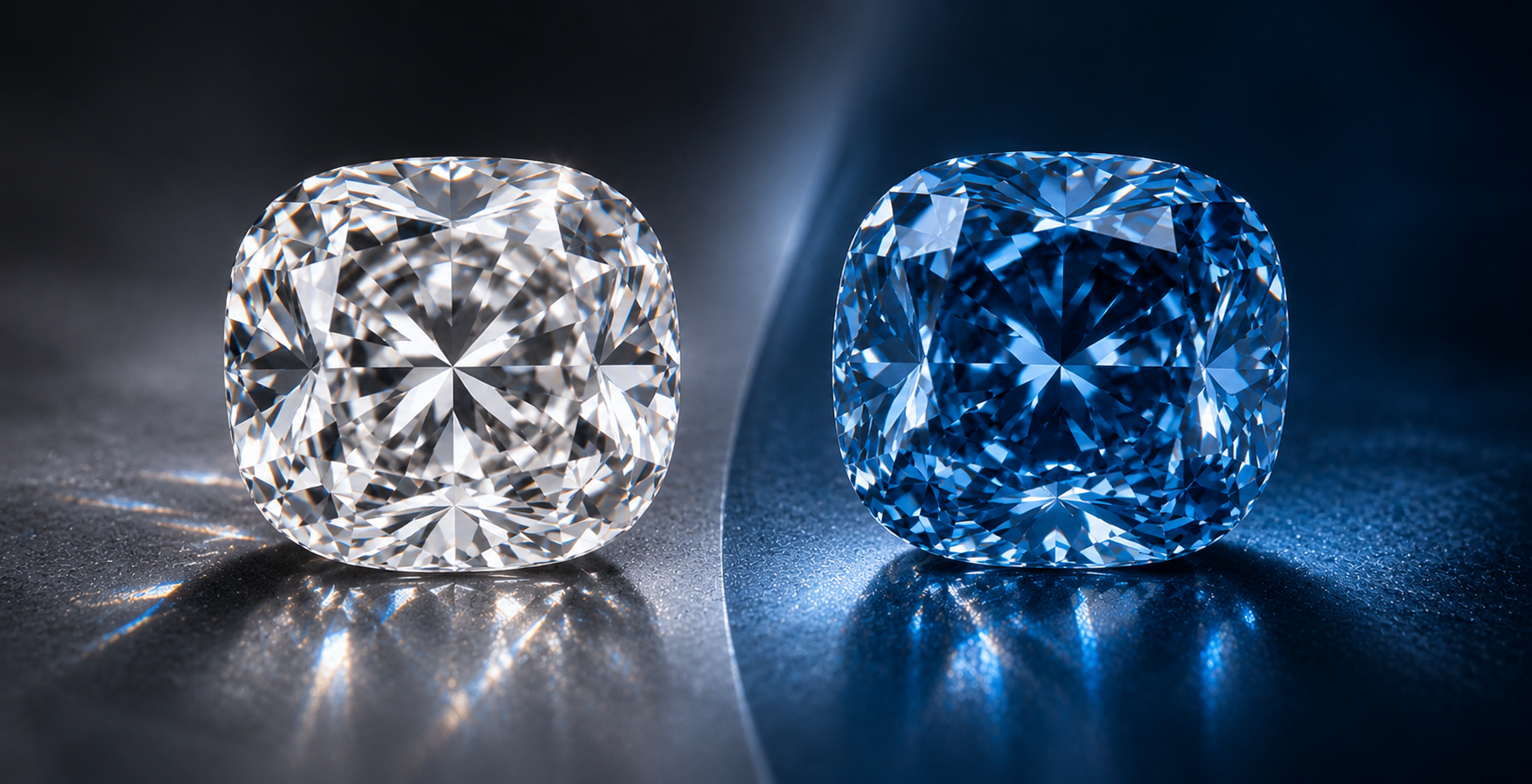
Boron can make some Type IIb diamonds semiconducting. This makes conductivity a potentially useful clue, especially when examining a blue or grayish-blue stone.
However, the measurement depends on probe contact, surface cleanliness, instrument design, and sensitivity. A positive reading alone cannot confirm Type IIb, natural origin, or treatment history.
Can Smart Tweezers or a Multimeter Detect Type IIb?
Conductivity tweezers and electrical meters may detect electrical behavior under suitable conditions, but they are not equivalent to a laboratory diamond-type determination. An inconclusive or negative result does not automatically exclude Type IIb, and a positive result requires corroboration.
Use such instruments only within their manufacturer’s specifications. Avoid improvised electrical testing that could damage equipment or a mounted gemstone.
Diamond and Moissanite Testers: Why Results Can Be Confusing
Some handheld testers use thermal and/or electrical properties to distinguish materials. Conductive diamonds may produce unusual readings on instruments designed for routine screening.
A ‘moissanite’ indication on a screening device is not a definitive identification of the material and is not proof of Type IIb. Follow up with appropriate gemological methods.
Other Useful Laboratory Techniques
UV-Vis-NIR absorption spectroscopy can contribute information about color mechanisms. Photoluminescence can reveal features associated with defects and growth history. Fluorescence and phosphorescence observations may be informative in context.
Microscopy and other methods help laboratories assess natural versus laboratory-grown origin and possible treatments. No single observation should be overinterpreted.
How to Read a Diamond Report
First confirm that the report belongs to the exact stone. Review the origin, color grade, color origin where relevant, clarity, measurements, and treatment disclosures. Then check whether the document explicitly includes diamond-type classification.
Not every standard grading report states Type IIa or Type IIb. If the type is absent, request separate laboratory evidence rather than inferring it from the color or other report fields.
A Practical Verification Workflow
- Record the diamond’s identification and existing report number.
- Check whether the laboratory has explicitly stated the diamond type.
- If not, request appropriate FTIR-based type analysis from a qualified gemological laboratory.
- Use conductivity and luminescence observations only as supporting information.
- Verify natural versus laboratory-grown origin, color origin, and treatments separately.
- Retain the supporting documentation before using the type claim in a listing.
This workflow helps reduce unsupported claims and improves the quality of information provided to buyers.
Frequently Asked Questions
Can a diamond tester identify Type IIa? No, a standard handheld tester is not a reliable type-classification method.
Is electrical conductivity proof of Type IIb? No.
Is FTIR useful for diamond typing? Yes, with expert interpretation.
Can a lab-grown diamond be Type IIb? Yes, which is why origin testing is separate.
undefined
Continue Exploring Diamond Types
- Complete Guide to Type IIa and Type IIb Diamonds
- What Is a Type IIa Diamond?
- Type IIb Diamonds: Boron and Blue Color
- Type IIa vs Type IIb: Comparison
- How to Test Diamond Types
Explore our Type IIa diamond category and Type IIb diamond category. Only diamonds supported by appropriate documentation should be described as having a verified diamond type.
Educational note: Illustrations and screening observations do not establish the type of an individual diamond. Request appropriate laboratory documentation.