


Type IIb Diamonds: Blue Color, Boron and Electrical Conductivity — This educational guide from Talore Diamonds explains the science, identification methods, and buying implications of diamond type. Type classification is separate from the 4Cs, natural origin, and treatment status.
What Is a Type IIb Diamond?
Type IIb diamonds are a subgroup of Type II diamonds with boron-related characteristics. Boron can influence optical absorption and electrical behavior. This makes Type IIb particularly interesting to gemologists and buyers of certain natural blue diamonds.
The classification is not a color grade or a guarantee of natural origin. Some laboratory-grown diamonds can also show boron-related properties, so a Type IIb claim must be considered alongside origin and treatment documentation.
How Boron Can Create Blue Color
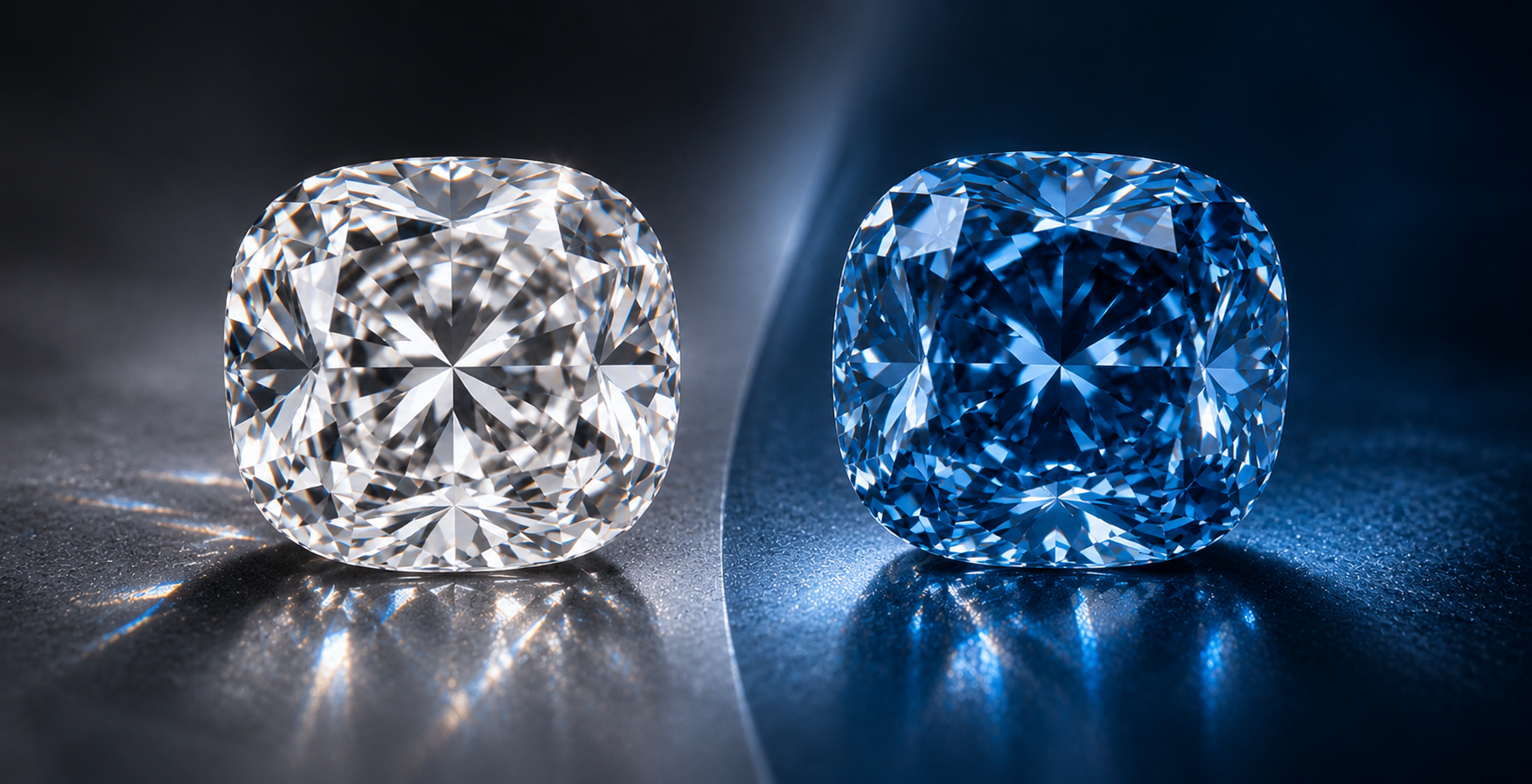
Boron in the diamond lattice can absorb parts of the visible spectrum, allowing a blue appearance. The intensity and nuance of the resulting color vary with the stone’s composition and other features. Type IIb diamonds may look blue, grayish-blue, or only faintly tinted.
The presence of a blue appearance alone is not proof of boron or Type IIb classification. Other color mechanisms and treatments can produce blue-looking diamonds.
Are All Natural Blue Diamonds Type IIb?
No. Many well-known natural blue diamonds are Type IIb, but not every natural blue diamond belongs to this type. Blue color must be investigated in its own right, and laboratory testing is necessary to establish both the color origin and the diamond type.
When comparing blue diamonds, pay attention to the laboratory’s wording: a report confirming natural color is not automatically a report confirming Type IIb.
Why Type IIb Diamonds Can Conduct Electricity
Boron can act as an acceptor impurity, making some Type IIb diamonds semiconducting. Most diamonds are electrical insulators, so this behavior is notable. However, conductivity can vary considerably between stones and test conditions.
Probe contact, surface condition, instrument sensitivity, and the geometry of the measurement can affect a reading. An electrical response can justify further testing but does not, by itself, prove Type IIb classification.
Will a Type IIb Diamond Test as Moissanite?
Some screening instruments distinguish diamond and moissanite partly through electrical behavior. A conductive diamond may therefore produce an unexpected result on certain testers. Such a reading does not establish that the stone is moissanite—or that it is definitely Type IIb.
Use an appropriate gemological identification workflow when a screening result conflicts with the stone’s documentation.
Fluorescence and Phosphorescence
Some Type IIb diamonds show interesting luminescence, including phosphorescence after ultraviolet illumination stops. The presence, strength, and duration of the effect differ from one diamond to another.
Fluorescence and phosphorescence are useful observations but are not standalone proof of diamond type, natural origin, or treatment status.
How Laboratories Confirm Type IIb
FTIR spectroscopy is a principal tool for assessing diamond-type characteristics, with additional gemological techniques used as needed. Laboratories may also examine UV-Vis-NIR absorption, photoluminescence, and other features to understand color origin and treatments.
A handheld conductivity tester cannot replace this work. Request explicit written support for the Type IIb classification if it is central to the purchase.
What Determines the Value of a Type IIb Diamond?
Natural blue diamonds can be highly desirable, but Type IIb classification alone does not determine value. The actual color appearance, natural color origin, carat weight, clarity, cut, treatments, and provenance are crucial.
Avoid assuming every Type IIb diamond is an intensely blue collector stone. Some are faintly colored, and some may be laboratory-grown.
Buying Questions to Ask
Ask whether the stone is natural, whether its color is natural, which laboratory established its type, and whether treatment testing has been performed. Check that the report number and measurements match the diamond.
If the seller mentions conductivity or phosphorescence, ask whether these are merely screening observations or conclusions supported by a qualified laboratory.
Frequently Asked Questions
Is every Type IIb diamond blue? No, visible color can be faint or variable.
Is every blue diamond Type IIb? No.
Can Type IIb diamonds conduct electricity? Many can, but a conductivity reading is not conclusive.
Can Type IIb diamonds be laboratory-grown? Yes.
undefined
Continue Exploring Diamond Types
- Complete Guide to Type IIa and Type IIb Diamonds
- What Is a Type IIa Diamond?
- Type IIb Diamonds: Boron and Blue Color
- Type IIa vs Type IIb: Comparison
- How to Test Diamond Types
Explore our Type IIa diamond category and Type IIb diamond category. Only diamonds supported by appropriate documentation should be described as having a verified diamond type.
Educational note: Illustrations and screening observations do not establish the type of an individual diamond. Request appropriate laboratory documentation.