

Type IIa vs Type IIb Diamonds: Key Differences Explained — This educational guide from Talore Diamonds explains the science, identification methods, and buying implications of diamond type. Type classification is separate from the 4Cs, natural origin, and treatment status.
Understanding the Difference
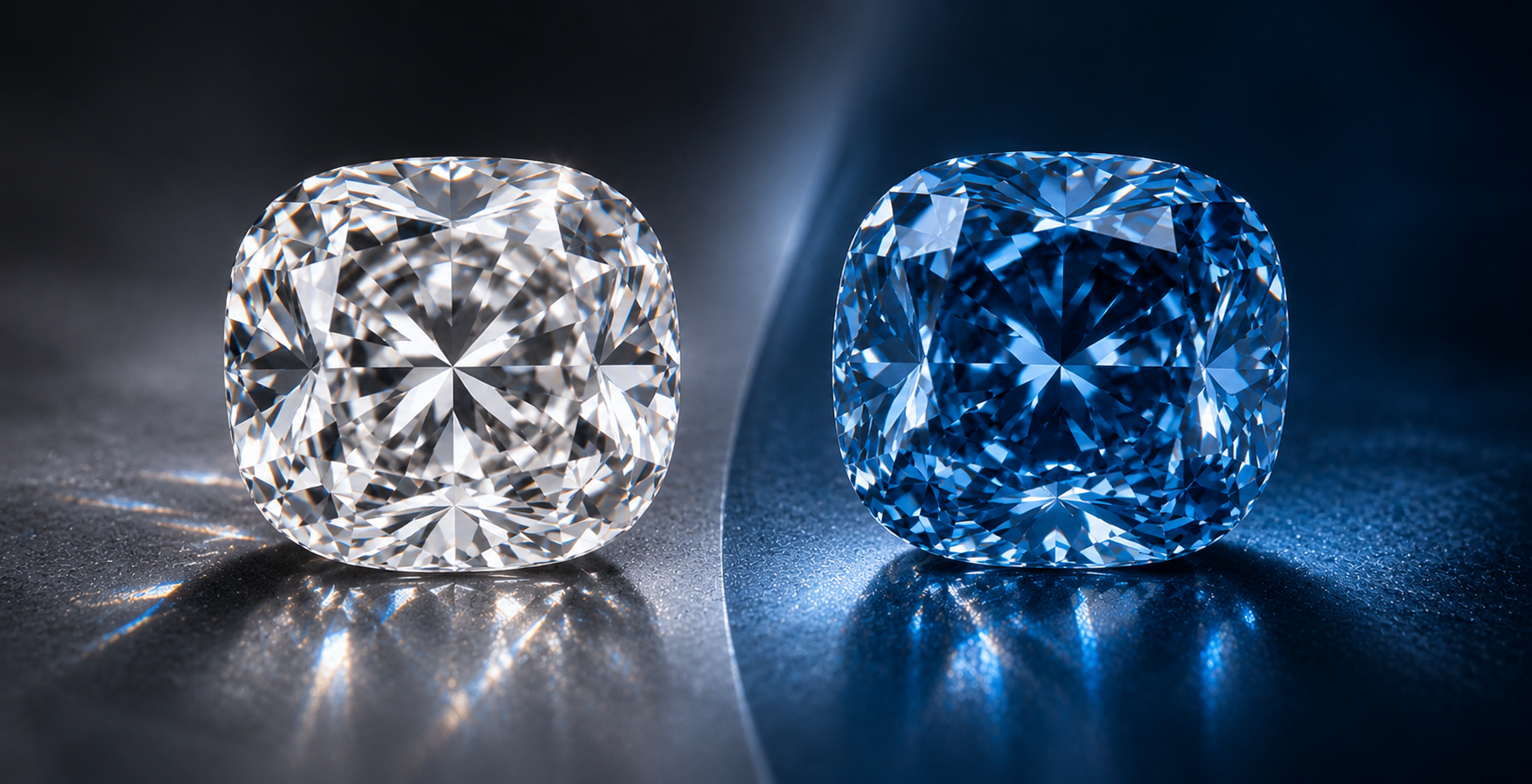
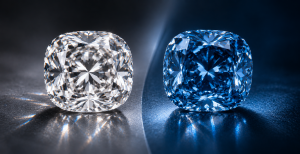
Type IIa and Type IIb are both part of the Type II diamond family, which lacks measurable nitrogen-related infrared absorption used in standard classification. The principal distinction is that Type IIb diamonds show boron-related features, while Type IIa diamonds do not show those features at the relevant detection level.
This is a classification of crystal chemistry, not a ranking of quality, value, or beauty.
Type IIa vs Type IIb Comparison Table
| Feature | Type IIa | Type IIb |
|---|---|---|
| Classification | No measurable nitrogen-related IR absorption | Boron-related features |
| Possible color | Colorless, pink, brown and others | Often blue or grayish, but variable |
| Electrical behavior | Generally insulating | May be semiconducting |
| Natural examples | Yes | Yes |
| Laboratory-grown examples | Yes | Yes |
| Can treatment occur? | Yes | Yes |
| Type verification | Laboratory spectroscopy | Laboratory spectroscopy and supporting observations |
These distinctions are general. The properties of any individual diamond require appropriate testing and interpretation.
Color: Does Type Determine Appearance?
No. A Type IIa diamond can be colorless or colored, and a Type IIb diamond need not display strong blue color. Some natural pink and brown diamonds are Type IIa, while boron-related absorption can contribute to blue in Type IIb diamonds.
A buyer should assess the diamond’s actual color and its reported origin separately from type.
Electrical Conductivity: A Useful Distinction
Type IIa diamonds are generally insulating, while some Type IIb diamonds conduct electricity due to boron-related electronic behavior. This difference can be useful in gemological screening.
But a conductivity reading is influenced by testing conditions and does not establish type, origin, or treatment on its own.
Natural vs Laboratory-Grown Diamonds
Both Type IIa and Type IIb classifications can occur in natural and laboratory-grown diamonds. Therefore, a type label cannot establish whether a diamond formed naturally in the Earth.
A report that confirms natural origin addresses a different question from a report or test identifying Type IIa or Type IIb.
Are Type IIa Diamonds Rarer Than Type IIb?
Both are minority categories within natural diamonds, but the answer depends on the population sampled and the exact criteria used. Universal percentage claims are often presented without sufficient context.
For a specific purchase, documented characteristics and genuine market comparables are more useful than an unsupported ranking of rarity.
Which Type Is More Expensive?
There is no fixed answer. Some exceptional natural blue diamonds command substantial prices, but this cannot be generalized to every Type IIb stone. Likewise, Type IIa does not automatically mean a premium price.
Compare natural origin, color grade and appearance, clarity, carat weight, cut, treatment status, and provenance before assessing value.
Which Should You Buy?
If you are drawn to natural blue diamonds, a documented Type IIb example may be particularly interesting. If you are researching colorless or certain pink diamonds, Type IIa may be relevant. Neither should be selected solely because of its label.
Choose a diamond that meets your color, quality, documentation, and budget requirements. Seek a qualified laboratory’s findings when diamond type is important to the transaction.
Frequently Asked Questions
Is Type IIb better than Type IIa? No, they are different classifications, not grades.
Does Type IIa mean colorless? No.
Does Type IIb mean natural blue? No.
Can I identify the difference with a photo? No, laboratory evidence is required.
undefined
Continue Exploring Diamond Types
- Complete Guide to Type IIa and Type IIb Diamonds
- What Is a Type IIa Diamond?
- Type IIb Diamonds: Boron and Blue Color
- Type IIa vs Type IIb: Comparison
- How to Test Diamond Types
Explore our Type IIa diamond category and Type IIb diamond category. Only diamonds supported by appropriate documentation should be described as having a verified diamond type.
Educational note: Illustrations and screening observations do not establish the type of an individual diamond. Request appropriate laboratory documentation.